Browsed by
Category: LIL-120-A

Sophomore year humanities course

Student Interview

Student Interview

The communications student I chose to interview is senior football player Zak Ramos.

2-3 Key Takeaways:

  1. Zak had a lot of great advice to give to younger communications students and offered some really good insight on making the most of your education. Zak said if he could go back to freshman or sophomore year he would participate in more things and take full advantage of the resources available to him here at UNE. Zak mentioned that the com major was sort of just starting up when he came in as a freshman, so there are even more opportunities available for students now.
  2. I also asked Zak to discuss what he thinks are the most valuable skills he has learned in college and the most important skills for a communications major to have. Zak explained how he thinks public speaking is one of the most valuable skills he has learned here at UNE, and that he’s used his public speaking skills in almost every class he has taken. When asked what the most important traits of a communications student are, Zak replied that persistence, grit, and not giving up after the first try are extremely important skills in communications.
  3. Zak also had many good things to say about the communications professor Jesse Miller, and recommended any class he teaches.

Faculty Interview Reflection

Faculty Interview Reflection

I interviewed Jesse Miller who is an english and communications professor here at UNE. I started the interview by asking him about his background and learned about how he ended up teaching here (worked many jobs from night bank manager to daily paper contributor). I also asked him to discuss the communications major program here at UNE and he had a lot of good things to say. Most notably he talked about the professor to student ratio here and the advantages of a small university allowing students more one-on-one time with professors. Jesse also mentioned that there are so many paths a communications student can take once leaving college as well as making the communication major whatever you want it to be. The gist that I got from him was that there are many different paths and options you can take and it’s just about jumping on those opportunities. Jesse also had good things to say about his fellow professors in the communications dept (Micheal Cripps, Sean Ramey, Matt Siegel) and how they work together as faculty to align their coursework. He also talked about how UNE really aims to create well-rounded communications students that can communicate in many ways, not just writing. Lastly, I asked Jesse about specific traits he sees in successful students and the biggest thing he talked about was students who have grit and resilience and don’t back down from challenges after one thing goes wrong.

Careers Examination

Careers Examination

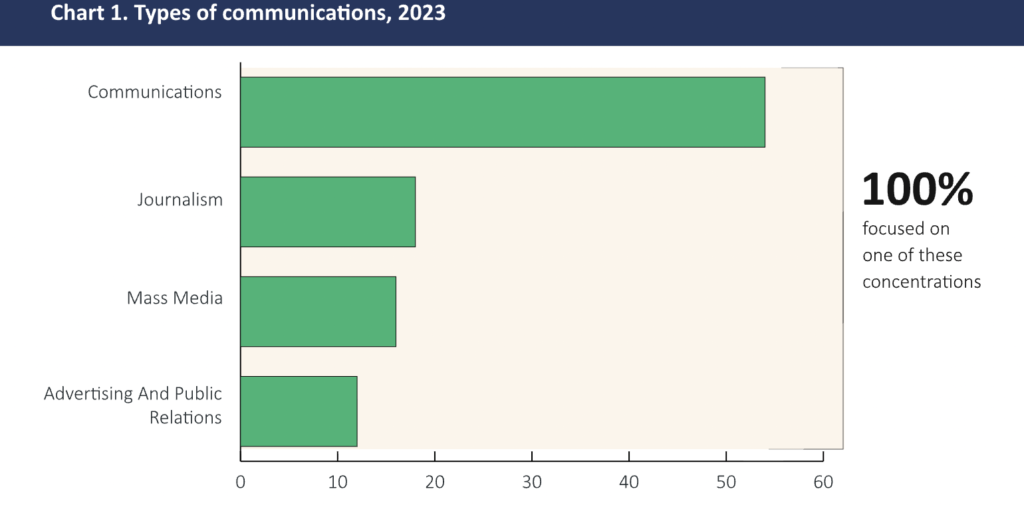
I did some deep digging into the “communications” tab, which is quite extensive and led me to many different pages to explore. It was super interesting to see all the different concentrations within the communications major, and then all the different jobs/occupations that come out of each of those concentrations, the possibilities are endless.

Here in chart 1 I looked into the communications concentrations options, which is a very broad span. Advertising and public relations is a concentration I would certainly be interested in exploring further. This stat stood out to me because it was interesting to see the 4 main concentrations that people in this major go into.

Here I was looking at the job statistics for marketing managers and was a bit surprised by how high the median pay was from 2024. I know managerial positions tend to make more, but I didn’t realize becoming a marketing manager, rather than just working in marketing, made such a difference in pay.

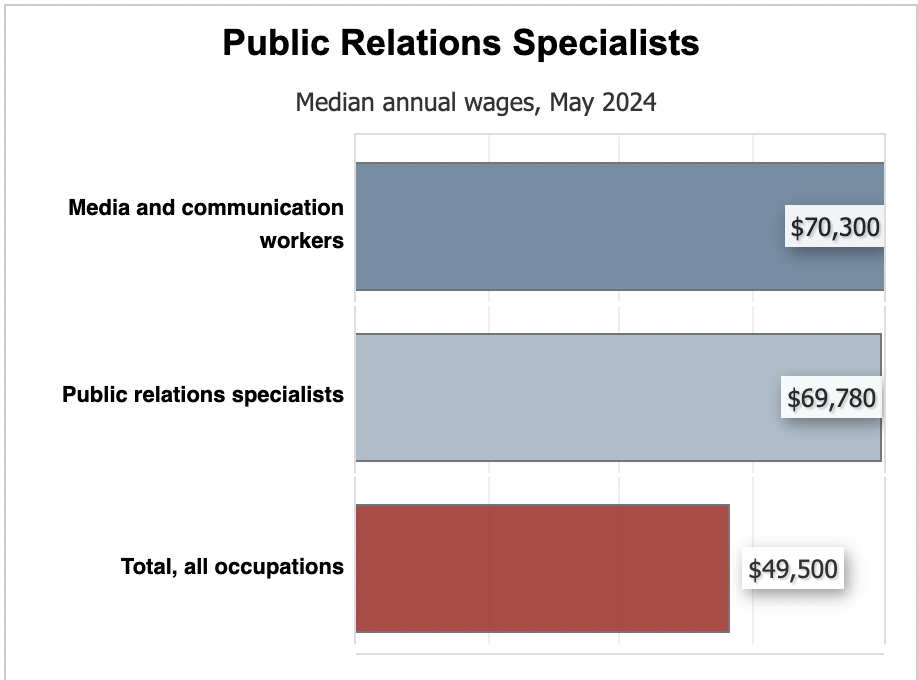
On this page I was looking further into public relations specialists in comparison to media/communications workers, and the incomes for both are pretty similar. I definitely have interest in the advertising side of communications, along with the public relations side that works with companies and clients.

Overall, I was pleasantly surprised by the findings of this activity. The median wages ended up being much higher than I had anticipated, there were SO many different fields/options to go into with a communications degree, and I was able to identify the specific concentrations that I am interested in within the communications major (marketing & public relations).

One Minute Podcast

One Minute Podcast

file:///Users/gretajennison/Music/Music/Media.localized/Music/Unknown%20Artist/Unknown%20Album/One%20Minute%20Podcast%20GJ%20-%2011_3_25,%209.10%E2%80%AFPM.m4a

This assignment was a lot more difficult than I originally expected it to be, but after lots of troubleshooting, I had success. The easy part was writing a script for myself and recording, the hardest parts were figuring out how to get the files where I wanted them to be and find a way to turn my project into a link (this was incredibly frustrating). Although I struggled a bit with technical stuff, I learned a lot and have a much better idea of what I am doing for next time!

Major Scavenger Hunt

Major Scavenger Hunt

  1. The communications and media arts major is part of the UNE College of Arts and Sciences. Communications and media arts majors study and learn how to communicate in today’s digital world. This major is a combination of communication skills, humanities, and the social sciences. One of the main goals is information sharing among different platforms, media, and more.
  2. Possible careers for a communications and media arts major includes a variety of jobs, allowing for tailoring to one’s interests/special skills. Positions communication and media arts majors have filled include blogger, journalist, public relations manager, marketing professional, video editor, TV studio manager, and more.
  3. UNE offers three different concentrations within the major. The three concentrations include Reporting and Public Relations, Digital video production, and sports media. There are specific courses offered for each concentration. Some courses listed for certain concentrations include sports field production (sports media), documentary video (digital video production), and public relations in the digital age (reporting and public relations), to name a few.
  4. I watched a short video on the UNE sports field production class and thought it looked super interesting. The video displayed some of the technology like cameras and phone cages that look very fun to use. It was a nice glimpse at what I will learn in that class and beyond within the sports media concentration.

QCQ Oct 21

QCQ Oct 21

Quotation:

“Man becomes really human only at the time of decision, when he exercises free will”.

Comment:

Wilkinson discusses the concept of evolution, free will, and innate human traits. He entertains a very interesting idea that humans are unique due to their ability to choose and make decisions. Many people still have doubts around Darwin’s evolutionary theory, and some even take it too far thinking that ALL traits/what happens in our lives is innate, but this simply isn’t true. We as humans have the ability to make decisions on our own, not from our biology controlling our actions, and this is extremely important to our existence. For we have adapted/survived over time, not because our bodies are built to endure any environment or obstacle, but because we as humans make choices that allow us to continue to live. Not only did we adapt to elements and create civilizations all over the world, we have continued to further the advancements of our society, by choice, not because we were forced to. For example, in early civilization it was necessary to build shelter to be protected from the elements (this was necessary for survival- not really a choice unless you want to die), and nowadays we have come so far and have advanced beyond survival, we CHOOSE to live.

Question:

At what point are advancements to our society unnecessary? Although all throughout time we have thought we are the most advanced we will get, we continue to break that record over and over, so how far is too far and what are some signs of over-advancement in our society today?

QCQ 3

QCQ 3

October 16 QCQ

Q:

“Most artists are brought to their vocation when their own nascent gifts are awakened by the work of a master. That is to say, most artists are converted to art by art itself.”

I chose this quote because I think it very much aligns with author Jonathan Lethem’s main points in “Ecstasy of Influence”. In this quote, he is explaining how most artists begin creating or discover their creative talents due to being inspired by “the work of a master”, which can be any piece of art. I also like how the last part ties in how artists are “converted”, which is a very interesting word to use because it implies some sort of change, which is something that art can create.

C:

I feel very personally connected to his idea of inspiration from other artists being the thing that sparks people to begin, or go back to creating. I have always loved art and grew up a very crafty person, but it has been very hard keeping up with that part of myself while at school because I am so busy. However, last fall embroidered sweatshirts started trending, and it inspired me to embroider a sweatshirt of my own. After this project, I continued creating and embroidering for a few weeks, and whenever I am brought back to the art of creation, I am reminded how much it means to me.

Q:

If all art that is created is influenced or inspired by art that came before it, where is the line of originality drawn, and how can we differentiate between inspiration and plagiarism?

2-1-Q oct 14

2-1-Q oct 14

Greta Jennison

13 October 2025

2 Comments:

  • On page 170, the panel in the bottom left corner shows the tragic death of George’s aunt and cousin who did not survive the bombing of Hiroshima. In this part of the book, the Takei family received a letter from relatives in Japan signifying that George’s Grandmother and Grandfather were still alive, but weeks later they received another letter explaining that their aunt and cousin sadly were not. The panel shows a vague outline of bodies resting at the bottom of an empty canal, and the text explains that their bodies caught on fire and they jumped into the canal to extinguish the fire, but tragically perished anyways. This panel is extremely powerful and exposes the sad truth about the amount of Japanese civilians who were killed in the bombing of Hiroshima.
  • On page 177, George is now all grown up and working as an actor in the musical “Fly Blackbird!” that ran for over a year and was hired to perform songs before civil rights rallies, most notably they performed before the speaker Reverend Dr Martin Luther King Jr. George was extremely moved by his speech and had the opportunity to meet him afterwards. The art in the panel that shows George meeting MLK Jr stood out to me because of the way the artist highlighted them shaking hands. Most of the panel is pretty darkly shaded, but there is a circle of highlighted light around the touching hands of the two men, signifying how much this meant to George and how magical it was.

1 Extension:

The Japanese city of Hiroshima was bombed on August 6th, 1945 at approximately 8:15am. The atomic bomb nicknamed “little boy” was dropped by a b-29 bomber by the name of Enola Gay. Over 70,000 people were killed instantly and thousands more lives were claimed by the shock wave and firestorm that engulfed the city after the initial explosion. This was the first use of atomic weapons in wartime and it created great fear and devastation, but was invented as a threat to end all wars. I read a very interesting letter from a pilot of the B-29 bomber to his son, explaining the extreme significance of his mission. In the letter he explains the reasons for the attack, and that the end goal of the bombing is to end all war. One sentence in particular that stood out to me was when he talks about how we no longer need to use a bunch of planes in a bombing, for “A single plane…can wipe out a city”/ 

1 Question:

How quickly did the news spread to Japanese Americans about the bombing? Were Japanese Americans still treated as “the enemy” even after America attacked Japan?

https://visit.archives.gov/whats-on/explore-exhibits/atomic-bombing-hiroshima-and-nagasaki

2-1-Q oct 7

2-1-Q oct 7

Greta Jennison

6 October 2025

2 Comments:

  • On page 146, Takei introduces a man named Herbert Nicholson who devoted so much of his time to bringing books and other goods to the camps. Herbert would visit the camps and bring books and other supplies that people needed. He even brought one of the camp residents’ dog to the vet when it was sick. I love how the art in the panels that feature this heartwarming gesture feels soft and creates a feeling of safety.
  • On page 149, we learn about public law 78-405. Public law 78-405 was a twisted policy that essentially gave Japanese americans the “right” to renounce their status as an american citizen, and accept the identity of alien enemy. This was the american government’s solution or almost like a snarky response to the “no-nos” (people who answered no on any question of the loyalty questionnaire).

1 Extension:

  • Herbert Nicholson
  • 1892-1983 
  • Born in Rochester, NY
  • Well known advocate for Japanese Americans
  • Learned to speak Japanese Fluently
  • Converted West Los Angeles Methodist church into a warehouse for supplies for the camps
  • Did all this work while sacrificing his life/money (slept on train rides to avoid hotel bills)
  • Was only allowed to bring into the camp what he could carry
  • Put over 50,000 miles on his Dodge truck transporting supplies
  • Delivered books, peoples belongings, pets, ashes of a loved one, and even dug up buried treasure

1 Question:

Why did Nicholson care so deeply about these strangers, and what did he get out of all this, if anything?

https://encyclopedia.densho.org/Herbert_Nicholson

2-1-Q sep 30

2-1-Q sep 30

Greta Jennison

6 October 2025

2 Comments:

  • Page 136 has a very interesting artistic design that helps explain what is going on in the story. In a moment of tension, two men from the camp face off, one asking “what did you call me?”. The art in this panel stood out to me because there is a dark shaded background and lots of harsh line patterns overlaying on the people in the panel, creating a feeling of tension and emotion.
  • On page 114, everyone in the camp is forced to take a “loyalty questionnaire” to prove their loyalty to the country. There were questions that accused these American born people of siding with the Japanese empire. I thought it was super interesting that on the next page there is a sort of comparison/list explaining his parents backgrounds and identities, it was super helpful to have a refresh on the history of his parents and was also helpful to moving the plot along.

1 Extension: 

People who answered no to any question on the questionnaire were immediately seen as disloyal and were sent to the Tule Lake internment camp in northern California. Tule lake was the largest camp and was in operation from 1942-1946. At its max capacity it held around 18,000 wrongfully incarcerated people, almost half being children (as Takei mentions). The camp had a high school, hospital, factories, a cemetery, and more. This camp was also heavily guarded with machine guns and surrounded by 3x the amount of barbed wire as other camps. Tule lake was also widely known for its segregation center with its own jail.

1 Question:

Were there any parents who answered no to the questions, but their adult son answered yes and was drafted? If so, what kind of effect did that have on their parents who were whisked away to the “disloyalty” camps?

https://www.nps.gov/places/tule-lake.htm

css.php